

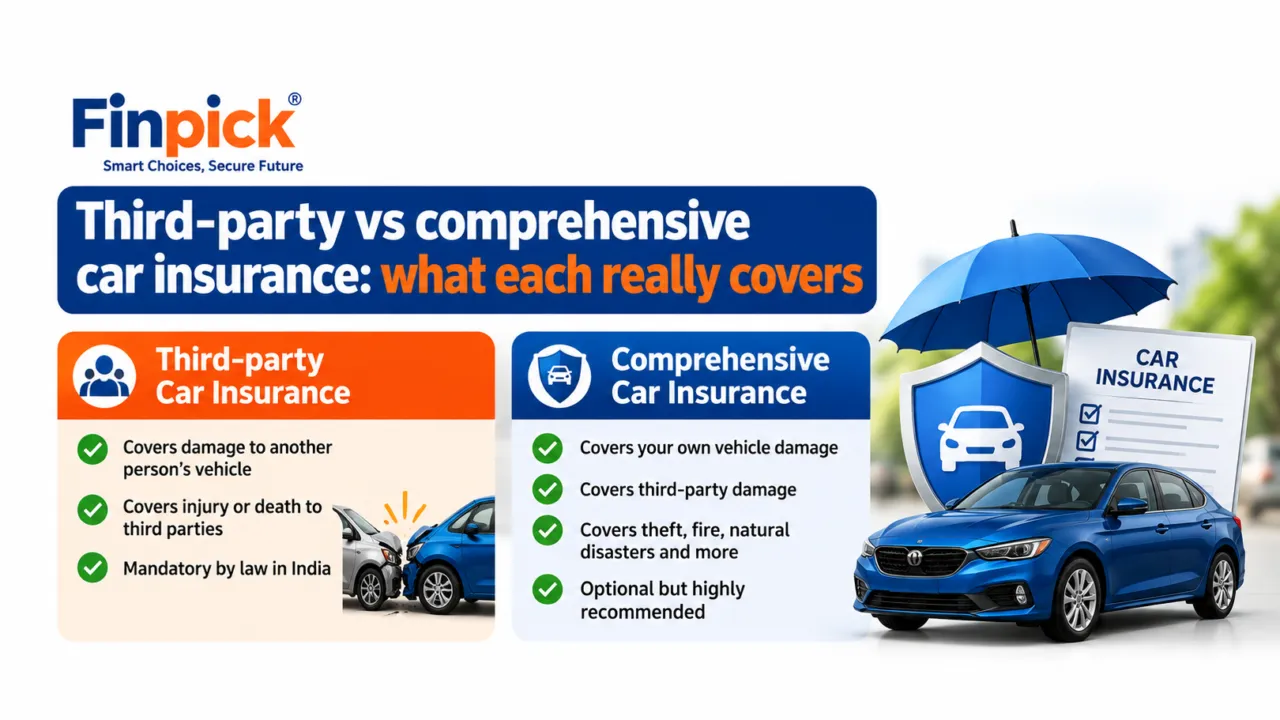
Third-Party vs Comprehensive Car Insurance: What Each Really Covers
You’re renewing your car insurance online, and two numbers stare back at you. The difference feels steep. You wonder if the cheaper option is enough.
Here’s what that gap buys: protection for your own car. Third-party cover is the legal floor, but it pays nothing when your vehicle is damaged. Comprehensive cover adds own-damage protection on top of the third-party base. The choice hinges on one question: can you afford to replace or repair your car out of pocket if something happens?
What the Law Requires
Section 146 of the Motor Vehicles Act, 1988 makes third-party motor insurance compulsory for any vehicle used in a public place. You cannot legally drive, or let someone else drive your car, without a policy that covers your liability to others. Central and State Government vehicles used for non-commercial purposes are excluded, and some authorities may be exempted by notification.
Driving without insurance attracts penalties under Section 196 of the Motor Vehicles Act. To find the current penalty amounts, visit the Ministry of Road Transport and Highways website (morth.nic.in) or ask your regional transport office.
Do this today: Check your car’s insurance expiry date right now. Set a phone reminder for 15 days before expiry so you have time to compare quotes.
What Third-Party Cover Actually Pays For
Third-party insurance covers your legal liability for:
- Death or injury caused to other people by your vehicle
- Damage to someone else’s property (their car, a shop front, a boundary wall)
It does not pay for:
- Damage to your own car
- Theft of your vehicle
- Fire, flood or natural calamity damage to your car
If you reverse into a parked car, third-party cover pays for the other car’s repair. If a tree falls on your car during a storm, third-party cover pays nothing. You bear the full cost.
Do this today: If you currently have only third-party cover, write down what you would do if your car were stolen tomorrow. If the answer is “I can’t afford to replace it”, you need comprehensive cover.
What Comprehensive Cover Adds
Comprehensive (also called package) cover bundles third-party liability with own-damage protection. Your vehicle is insured up to a figure called the Insured’s Declared Value, or IDV.
The IDV is calculated from the manufacturer’s listed selling price of your car, minus depreciation based on the vehicle’s age. For cars older than about five years, or models no longer in production, the IDV is agreed between you and the insurer rather than pulled from a standard table.
Think of the IDV as the maximum the insurer will pay for your car in a total-loss scenario. It’s not the price you paid, and it’s not the price you’d pay to buy the same car today. It’s the depreciated value the insurer assigns.
Do this today: Pull out your current motor policy (or log in to your insurer’s portal) and find the IDV on the schedule. Write it down. For cars over about five years old, the IDV is negotiable, so if you believe the insurer’s offer is too low, ask them in writing how they arrived at the figure and whether you can provide a surveyor’s valuation to support a higher IDV.
How a Claim Is Settled
When you file an own-damage claim under a comprehensive policy, the insurer assesses whether the car can be repaired or is a total loss.
A total loss is declared when:
- The car is stolen and not recovered, or
- The repair cost exceeds 75% of the IDV (this threshold is specified in the Universal Sompo policy wording; other insurers may use a different percentage, so check your policy document or ask your insurer in writing).
In a total-loss scenario, you receive the IDV (minus any deductible stated in your policy).
If the car is repairable, the insurer pays for parts and labour, but here’s the catch: standard comprehensive policies apply depreciation to replaced parts. Paint, for example, is depreciated by 50%. Rubber, fibre and nylon parts are depreciated at higher rates. You pay the depreciated portion out of pocket, or the garage adjusts the bill and you settle the difference.
The goosebumps moment: say your car’s IDV is ₹6,50,000. At a 75% total-loss threshold (the threshold in the Universal Sompo policy wording; other insurers may use a different percentage, so check your policy document), any repair estimate above ₹4,87,500 triggers a total-loss declaration. That’s not a dramatic crash. That’s a flooded engine and a damaged interior. One monsoon, one wrong turn, and you’re at the threshold. Comprehensive cover is the difference between a cheque for ₹6,50,000 (minus deductible) and a bill for ₹4,87,500 that you pay yourself.
Do this today: Read the depreciation table in your policy wording (it’s usually in the annexure or definitions section). Note the rates for paint, rubber and plastic. If you can’t find it, email or WhatsApp your insurer and ask for the full depreciation schedule.
A Worked Example (All Figures Are Assumed for Illustration Only)
Let’s say you bought a hatchback in 2020 for ₹8,00,000. In 2025, the car is four years old. For this illustration, we’ll assume the insurer calculates an IDV of ₹6,50,000 (your actual IDV will depend on your insurer’s depreciation table and your car’s make and model).
Scenario 1: The car is stolen.
- Third-party policy: pays ₹0 for your car.
- Comprehensive policy: pays ₹6,50,000 (the IDV), minus any deductible.
Scenario 2: You’re in an accident. The front bumper, bonnet and headlights need replacement. For this illustration, assume the garage estimates ₹85,000 for parts and labour.
- Third-party policy: pays ₹0 for your car.
- Comprehensive policy (standard): pays ₹85,000 minus depreciation on the replaced parts. If we assume depreciation totals ₹18,000, you receive ₹67,000. You pay the ₹18,000 gap.
- Comprehensive policy with zero-depreciation add-on: pays the full ₹85,000 (subject to the add-on’s terms: some have claim-count limits or exclude certain parts).
Scenario 3: For this illustration, assume the repair estimate is ₹5,00,000, which is 77% of the IDV.
- The insurer declares it a constructive total loss (repair cost exceeds 75% of IDV).
- You receive ₹6,50,000 (the IDV), and the insurer takes the salvage.
Do this today: Take your car’s current IDV and multiply it by 0.75. That’s the repair-cost threshold where your insurer will likely declare a total loss instead of repairing. Write that number down and ask yourself: could one accident reach that figure?
Who Needs Comprehensive Cover
If you financed your car with a loan, your lender almost certainly required comprehensive cover as a condition of the loan. The car is collateral; the bank wants it protected. You cannot switch to third-party-only until the loan is fully repaid.
If you own the car outright, the choice is yours. A third-party-only policy satisfies the law but leaves you exposed. If your car is old and the IDV is low, you might decide the comprehensive premium isn’t worth it and self-insure the own-damage risk. If your car is relatively new or you can’t afford to replace it, comprehensive cover is the safer bet.
Business owners with commercial vehicles face the same legal requirement for third-party cover and the same choice. Vehicles carrying hazardous goods also need cover under the Public Liability Insurance Act, 1991.
Quick self-check (tick the ones that apply to you):
- [ ] My car is less than 5 years old
- [ ] I can’t afford to replace my car out of pocket
- [ ] I drive in flood-prone areas or areas with heavy traffic
- [ ] My car’s IDV is above ₹3,00,000
- [ ] I have an active car loan
If you ticked two or more, comprehensive cover is worth the premium. If you ticked none, third-party-only might be enough, but only if you’re genuinely prepared to scrap the car and move on if something happens.
Do this today: If you have a car loan, check your loan agreement or ask your lender in writing whether you’re required to maintain comprehensive cover. If yes, you have no choice until the loan is repaid.
The Add-Ons That Change the Arithmetic
Standard comprehensive cover has gaps. Add-ons plug some of them, for an extra premium:
- Zero depreciation (Depreciation Waiver): The insurer pays the full cost of replaced parts, with no deduction for age. This add-on often has age limits (commonly around five years, but this varies by insurer) and may cap the number of claims you can make in a year.
- Engine protect: Covers damage to the engine and gearbox from water ingress or oil leakage, which standard policies exclude.
- Return to invoice: If the car is a total loss, you receive the original invoice price rather than the depreciated IDV. Useful for new cars in the first year or two.
- Roadside assistance: Towing, flat-tyre help, emergency fuel. Some insurers bundle this free; others charge.
- NCB (No Claim Bonus) protection: Lets you make one or two claims without losing your no-claim discount on renewal.
Add-on names, availability, age limits and terms vary by insurer. To find out which add-ons are available for your car and what they cost, ask each insurer for a detailed quote in writing, or check the policy brochure on the insurer’s website. Read the policy wording, not just the brochure.
If you can afford only one add-on, zero depreciation gives the biggest gap-fill for cars under five years old, because parts are expensive and the 50% paint depreciation alone can leave you with a large out-of-pocket bill.
Do this today: If your car is under four years old, get a quote with and without zero depreciation from two insurers. Compare the premium difference with the depreciation you’d pay on a realistic parts bill (use the 50% paint depreciation rate as a rough guide). If the add-on costs less than the depreciation you’d save in one realistic claim, it’s worth it.
Why FinPick Helps You Compare
Most buyers compare only the bottom-line premium and assume all comprehensive policies are identical. They’re not. The IDV, the depreciation schedule, the total-loss threshold and the add-on terms differ across insurers. A cheaper premium might come with a lower IDV, which means less in your pocket if the car is stolen.
The real decision isn’t third-party versus comprehensive in the abstract. It’s: what is my car’s current IDV, what would I pay out of pocket in a realistic claim scenario, and is the premium difference worth that protection? For a car worth ₹6,00,000, the comprehensive premium buys peace of mind. For a car worth ₹80,000, it might not.
Zero depreciation add-ons often have age limits (commonly around five years, but this varies by insurer). For newer cars, where parts are expensive and the add-on premium is a small fraction of a likely claim, it often makes economic sense. For older cars, the add-on premium can approach the cost of the parts you’d save, and the math may not work. Run the numbers for your car’s age and IDV.
Don’t under-insure to save premium. A small saving today can become a large shortfall at claim time.
FinPick as a distributor helps you navigate insurer differences: we compare IDV calculations across three insurers for your car’s make, model and year, show you the depreciation schedules side by side, and walk you through which add-ons make sense for your driving pattern and budget. We don’t push the highest premium; we show you the arithmetic, then you decide.
Frequently Asked Questions
Q: Can I buy only third-party cover if my car is new?
A: Legally, yes. Practically, no, if you have a car loan; the lender will require comprehensive cover. If you own the car outright, you can choose third-party only, but you’re taking the full financial risk of damage or theft.
Q: If I never claim, do I get my premium back?
A: No. Insurance is risk transfer, not a savings product. If you don’t claim, most insurers offer a no-claim bonus (NCB) discount on renewal. Ask your insurer for the NCB scale in writing.
Q: Can I switch from third-party to comprehensive mid-year?
A: No. You can only change cover type at renewal. If you want comprehensive cover now, you’d have to cancel the existing policy (you may get a pro-rata refund minus charges) and buy a new comprehensive policy.
Q: What happens if the other party in an accident doesn’t have insurance?
A: Your own comprehensive policy will pay for your car’s damage (subject to your deductible), regardless of the other party’s insurance status. For details on pursuing the other party for recovery, consult a lawyer or ask your insurer.
Q: Does comprehensive cover include personal accident cover for me?
A: Personal accident cover for the owner-driver is often bundled with motor policies. Check your policy schedule or ask your insurer in writing to confirm what is included and the sum insured.
Q: How is IDV decided for a car older than five years?
A: The insurer and owner agree on the IDV, taking into account the car’s condition, any modifications, and the second-hand market price. If you feel the insurer’s offer is too low, you can negotiate or get a surveyor’s valuation.
What to Do Next
Third-party insurance keeps you legal. Comprehensive insurance keeps you solvent when something goes wrong. The law requires the first; common sense often requires the second.
The right choice depends on your car’s value, your ability to absorb a loss, and whether you’re financing the vehicle. For example, a ₹10,00,000 car with a loan needs comprehensive cover. A ₹60,000 car you own outright might not, if you can afford to scrap it and move on.
Before you renew, check your IDV, read your depreciation schedule, and compare quotes on equal terms (same IDV, same add-ons). If you’re not sure whether an add-on is worth the extra premium, ask your insurer or a FinPick adviser to walk you through a realistic claim scenario with your car’s actual IDV and typical parts cost for your make and model. The arithmetic will tell you.
Your action list:
- Find your current IDV on your policy schedule and write it down.
- Set a phone reminder for 15 days before your policy expiry to start comparing renewal quotes.
- Read the depreciation table in your policy wording (or ask your insurer for it in writing).
- If your car is under four years old, get quotes with and without zero depreciation from two insurers and compare the premium difference.
- Bring your car’s registration certificate, current policy copy and IDV to a call with a FinPick adviser.
Not sure which cover level fits your car and your budget? Reply to a FinPick adviser on WhatsApp with your car’s make, model, registration year and the number of self-check boxes you ticked. We’ll walk you through the IDV, the add-ons that make sense for your situation, and three quotes you can compare on equal terms.
FinPick is an AMFI-registered Mutual Fund Distributor (ARN-121216) and BSE member 23798, offering general insurance distribution. We don’t push products; we show you the arithmetic, then you decide.