
Home loan eligibility: income, existing EMIs and how banks decide
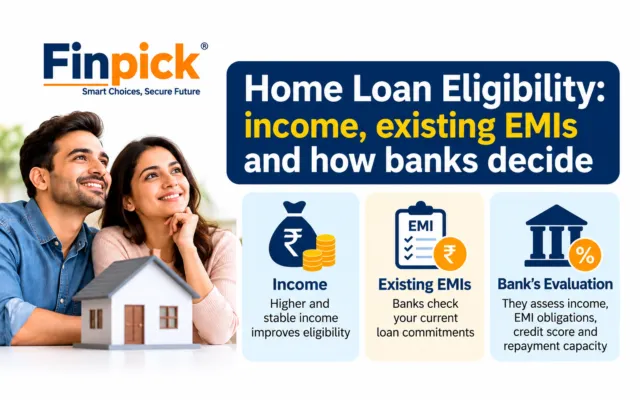
RBI sets a ceiling on how much you can borrow against the property, but your actual eligibility comes down to a simple income-and-EMI calculation that you can work out yourself.

ARN-121216 · AMFI Registered Mutual Fund Distributor
Mutual funds, insurance and loans, written from primary sources and checked before they are published. No tips, no jargon, no pressure.
Illustration only. The return rate above is an assumption you chose, not a promise. Mutual fund investments are subject to market risks — read all scheme related documents carefully. Actual returns vary year to year and can be negative.
Illustration only. The interest rate is an assumption you chose. The rate and EMI you are actually offered depend on the lender, your credit profile, the loan type and fees. Please confirm final terms with the lender before you decide.
RBI sets a ceiling on how much you can borrow against the property, but your actual eligibility comes down to a simple income-and-EMI calculation that you can work out yourself.

The arithmetic is simple, but AMFI and SEBI both say there are no guaranteed returns and your principal can go down.
There is no regulatory rule on emergency fund size in India, but here is how to calculate the right number for your household.
RBI sets a ceiling on how much you can borrow against the property, but your actual eligibility comes down to a simple income-and-EMI calculation that you can work out yourself.

Understand how each method works, what rupee cost averaging really does, and how to match your cash flow to the right investment approach.
A step-up SIP lets you increase your instalment every year without starting fresh, here's the arithmetic and what to fill in the form.
The same ₹12 lakh invested can illustrate maturity values from ₹16.5 lakh to ₹23.2 lakh, depending on the rate you assume.
A plain-language guide to systematic investment plans, rupee cost averaging and what SEBI's own numbers show.
हेल्थ इन्शुरन्सच्या प्रीमियमवर सेक्शन 80D (नवीन कायद्यात कलम 126) अंतर्गत किती वजावट मिळते, किती tax वाचतो आणि कोणत्या चुका टाळाव्यात, सोप्या मराठीत.
पुण्यातील कुटुंबासाठी हेल्थ इन्शुरन्स कव्हर किती हवे, बेस पॉलिसी अधिक सुपर टॉप-अप कसे वापरावे आणि पॉलिसी घेण्यापूर्वी काय तपासावे, सोप्या मराठीत.
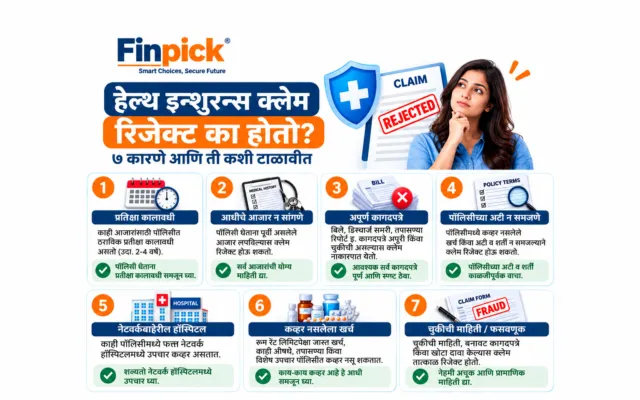
हेल्थ इन्शुरन्स क्लेम नाकारला जाण्याची ७ मुख्य कारणे, ती कशी टाळावीत आणि क्लेम नाकारला गेला तर पुढे काय करावे, सोप्या मराठीत.
Since 2019, your floating-rate home loan resets at least once every three months, and from 2023, you can choose what happens next.
From January 2026, prepayment penalties vanish on floating rate home loans, but upfront fees still range from ₹20,000 to ₹50,000 across lenders.
From 1 January 2026, no pre-payment penalty on floating-rate home loans, but does the math actually work for you?
One shared pot or four separate covers, the choice shapes your premium, your protection and what happens when one person falls seriously ill.
The legal minimum protects others, not your car: here's the arithmetic behind the choice.
Choosing a hospital room above your policy's daily limit can slash your entire claim, not just the room rent line.
The law says you must buy third-party cover, but it won't pay a rupee if your own car is stolen or smashed.
Protection, emergency fund, goals, retirement and tax: here's how to map your money so nothing falls through the cracks.
A 20% co-pay can cut your premium by ₹6,000 a year, but one large claim could wipe out sixteen years of that saving.
Rules and figures come from SEBI, AMFI, IRDAI, RBI and PFRDA, not from other blogs.
Every finance and insurance article is checked by a registered professional first.
If we get something wrong we fix it and say so on the article.
We will look at the rate, the tenure and what prepayment actually saves you.