
Family Floater vs Individual Health Insurance: Which One Protects Your Family Better?
Your spouse needs ₹8 lakh for surgery. You have a ₹10 lakh family floater. The insurer pays the bill, but now only ₹2 lakh remains for you and your two children for the rest of the year. If your child falls ill next month, you’re paying out of pocket.
That shared pot is the single biggest difference between a family floater and individual policies, and most families don’t see it until a claim lands.
What a Family Floater Actually Means
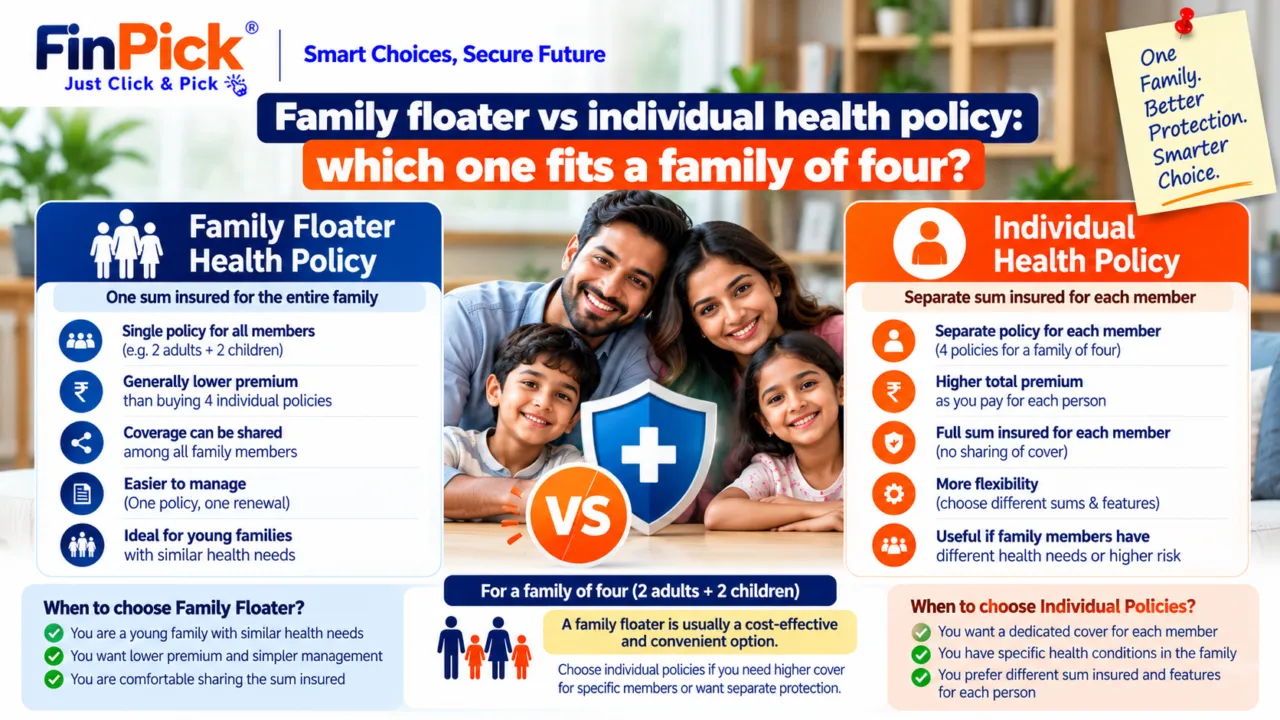
A family floater is one policy with one sum insured shared by everyone you cover. Buy a ₹10 lakh floater for four people, and that ₹10 lakh sits in a single pot. Any member can claim from it, in any combination, until it’s empty. Once it’s empty, no one has cover until renewal.
An individual policy gives each person their own separate sum insured. Four people with ₹5 lakh each means four separate ₹5 lakh pots. One person’s claim never touches another’s cover.
Do this today: Pull out your current health policy. Check whether it says “family floater” or lists each member separately. Note the sum insured and whether it’s shared or per person.
How the Premium Is Calculated
In a floater, the insurer pegs the premium to the eldest member’s age, your family size and your city. You’re 35, your spouse is 33, two children. The premium is based on your age (35). When you turn 50, the premium jumps for everyone, even though your children are still young.
In individual policies, each person pays for their own age. Your children’s premiums stay low even as yours rises.
Research from ManipalCigna shows floaters are most cost efficient between ages 35 and 49. From age 50 onwards, individual policies often cost less. Above 60, a separate senior citizen plan for parents beats adding them to the household floater.
Do this today: List each family member’s age. If the eldest is above 45, ask your insurer in writing for a premium quote for both a floater and individual policies at today’s rates.
The Shared Pot Risk: A Worked Example
You (38), your spouse (36), two children (8 and 5). You have a ₹10 lakh family floater.
Your spouse needs surgery. The bill is ₹8 lakh. The insurer pays ₹8 lakh from the floater. That leaves ₹2 lakh for you and the two children for the rest of the year.
Two months later, your child needs treatment costing ₹3 lakh. The insurer pays ₹2 lakh (the remaining sum insured). You pay ₹1 lakh out of pocket. After that, no one in the family has cover until renewal.
Now the same family with four individual ₹5 lakh policies:
Your spouse needs the ₹8 lakh surgery. The insurer pays ₹5 lakh (your spouse’s limit). You pay ₹3 lakh out of pocket. Your spouse’s cover is exhausted, but you still have your ₹5 lakh, and each child still has their ₹5 lakh untouched. When your child needs treatment, their full ₹5 lakh is available.
The floater gives you a bigger shared pot, but one large claim can leave the others unprotected. Individual policies cap each person at ₹5 lakh, but each person’s cover is independent.
(This is an illustration to show the mechanism, not a projection of real claims or premiums.)
Do this today: Ask yourself: if one family member claimed 80% of your current sum insured this year, would the remaining 20% be enough for the other three?
When a Floater Works
Floaters suit young, healthy, small nuclear families where the chance of multiple large claims in one year is low. Star Health, Niva Bupa and PolicyBazaar all say the same thing: if both adults are under 40, you have two children, and no one has a chronic condition, a floater usually costs less than buying four individual policies.
The cost saving is real. You’re pooling the risk, and the insurer prices that pool lower than four separate policies.
Do this today: If everyone in your family is under 40 and healthy, a floater is likely your best option. Confirm the sum insured is at least ₹10 lakh (₹15 lakh or ₹20 lakh is safer in metro cities).
When Individual Policies Work Better
Individual policies make sense when:
- The eldest member is above 50. The floater premium rises with their age, even if the others are young. Splitting into individual policies may cost less.
- You have elderly parents. Adding parents above 60 to your floater can double or triple the premium. A separate senior citizen policy for them is usually cheaper.
- One family member has a pre-existing condition or claims often. Individual cover for that person protects the others’ sum insured.
- Your family is large (more than four people). The floater premium rises with family size, and the shared pot gets stretched thin.
Star Health recommends individual plans for bigger families or those with senior parents. ManipalCigna says parents above 60 are better on a separate senior plan.
Do this today: If anyone in your family is above 50 or has a chronic condition, ask your insurer for a written quote comparing a floater, individual policies, and a hybrid (floater for the couple, separate cover for parents or the unwell member).
The Hybrid Strategy
The most common structure advisers recommend: a floater for the couple, individual policies for elderly parents, and sometimes separate cover for a child with a health condition.
This balances cost and protection. The couple shares a pot (lower premium), the parents have their own cover (no age penalty on the couple’s floater), and the child with the condition has ring-fenced cover (their claims don’t exhaust the family pot).
ManipalCigna’s research supports this: floater for the couple, separate senior plan for parents above 60.
Do this today: If your parents are above 60 or one family member has a health issue, sketch out the hybrid structure on paper. List the premium for each piece and add them up. Compare that total to your current floater premium.
The Tax Angle
Under Section 80D (old tax regime only), you can claim a deduction of up to ₹25,000 for health insurance premiums paid for yourself and your family. You get an additional ₹25,000 for premiums paid for your parents (₹50,000 if your parents are senior citizens).
This applies whether you buy a floater or individual policies. The limit is on the premium amount, not the number of policies.
Source: Star Health, Income Tax Department.
Do this today: Check your last tax return. Did you claim Section 80D? If you’re on the old tax regime, add up this year’s health insurance premiums and see how much you can deduct.
What the Research Doesn’t Tell Us
The research does not give actual premium figures for a family of four, or recommended sum insured amounts. Those numbers vary by insurer, city and your health profile, and they change every year.
The research also does not say whether restoration benefits (where the insurer tops up the sum insured if it’s exhausted mid-year) are available in floaters or individual plans, or what the terms are. Ask your insurer in writing.
Child age limits vary by insurer. Star Health covers dependent children up to age 26. Other insurers may differ. Read your policy wording.
Do this today: If your policy mentions restoration or recharge benefits, highlight that section and ask your insurer in writing: “If the sum insured is exhausted in month six, does it restore? What are the conditions?”
What to Do Next
- List each family member’s age and any known health conditions on one page.
- Check your current policy document. Is it a floater or individual? What is the sum insured? Is it shared or per person?
- If the eldest member is above 45, or if one member has a chronic condition, ask your insurer in writing for premium quotes for: (a) a family floater, (b) individual policies for each member, (c) a hybrid structure.
- Calculate your Section 80D deduction. If you’re on the old tax regime, add up your health premiums and see what you can claim.
- Ask yourself: if one person claimed 80% of the sum insured this year, would the rest be enough for the others?
Bring your current policy document, your family’s ages, and any recent medical reports when you speak to an adviser.
Not sure which structure fits your family? Share your ages, city and current sum insured with a FinPick adviser on WhatsApp. We’ll model both options for you in 10 minutes and show you the premium difference in rupees.
FinPick is an AMFI-registered distributor (ARN-121216) and BSE member (23798). We help families structure health insurance that actually protects everyone, not just the policy document.