

You’re renewing your car insurance online, and the screen shows two prices. The difference feels huge. You wonder if you really need to spend much more for comprehensive cover.
Here’s what that price gap buys you, and what it leaves out.
What the Law Actually Says
Section 146 of the Motor Vehicles Act, 1988 is clear: you cannot use a motor vehicle in a public place, or let anyone else use it, unless a complying third-party insurance policy is in force. Drive without it and you’re breaking the law. (Central and State Government vehicles used for non-commercial purposes are excluded, and some authorities may be exempted by notification. Vehicles carrying hazardous goods also need cover under the Public Liability Insurance Act, 1991.)
Third-party cover is the legal minimum. Comprehensive is optional, but most banks and NBFCs will insist on it if you’ve taken a car loan, because your vehicle is their collateral until you finish paying.
Key Facts
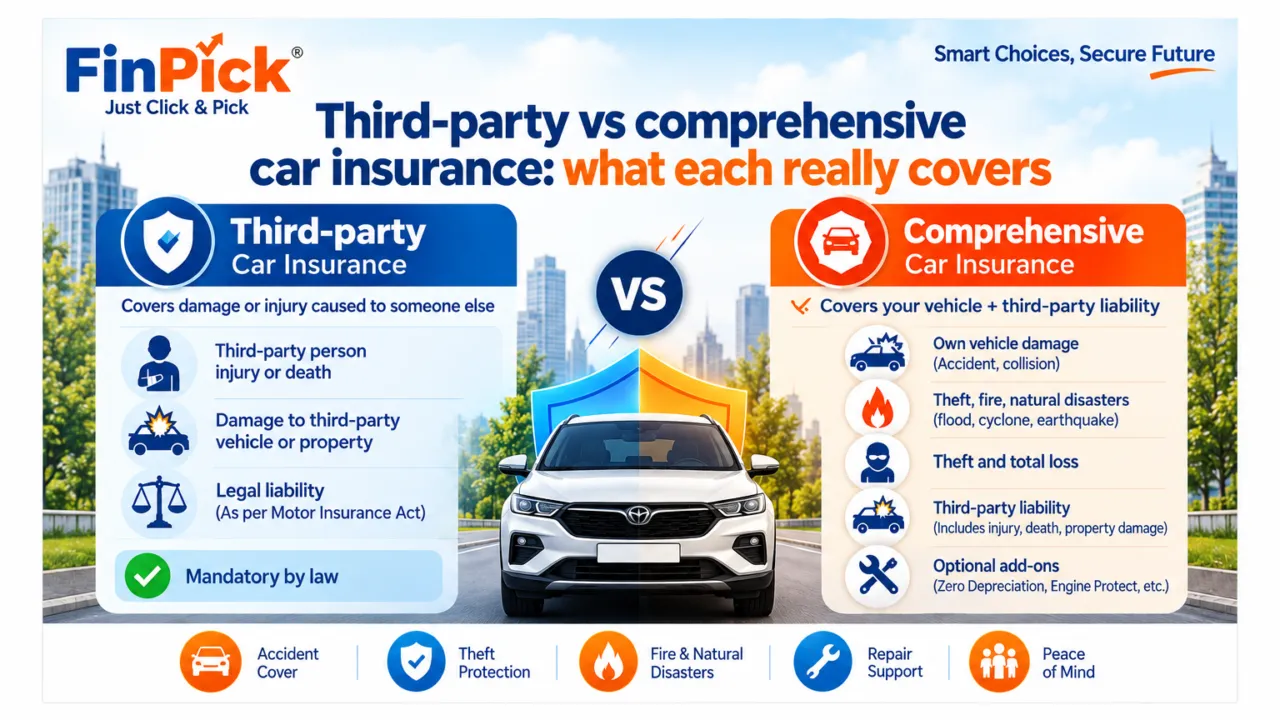
- Third-party cover pays for your legal liability when your vehicle causes death, injury or property damage to others. It does not pay for damage to your own car.
- Comprehensive (package) policies add own-damage protection on top of the mandatory third-party cover.
- The Insured’s Declared Value (IDV) is the sum insured for your vehicle, calculated from the manufacturer’s listed selling price minus depreciation by age.
- For vehicles over about five years old and obsolete models, the IDV is agreed between you and the insurer.
- A claim is settled as a total loss at the IDV when repair cost exceeds 75% of IDV (per the Universal Sompo policy wording).
- Standard comprehensive policies reduce payment for replaced parts by age-based depreciation (for example, paint is depreciated by 50%).
- Add-ons such as zero depreciation, engine protect, return-to-invoice, roadside assistance and NCB protection are insurer-specific in name, availability, age limits and claim counts.
Why It Matters
If you choose third-party-only to save premium, you are self-insuring your car. Every rupee of repair, replacement or loss comes from your pocket. If your car is stolen, written off in an accident or badly damaged, the insurer pays nothing for your vehicle.
If you choose comprehensive, you are protected up to the IDV, but the actual payout is reduced by depreciation on replaced parts unless you buy a zero-depreciation add-on. The premium is higher, but the risk shifts to the insurer.
The trade-off is arithmetic: how much you save in premium versus how much you would pay out-of-pocket if something happens to your car.
How It Actually Works
Third-Party Cover
You hit another car at a signal. The other driver’s bumper is cracked and their door is dented. Your third-party policy pays for their repair bill and any injury claim. Your own car’s damage? You pay.
You reverse into a wall. Your bumper is smashed. Third-party cover pays nothing, because a wall is not a third party and you caused the damage yourself.
Someone steals your car. Third-party cover pays nothing, because theft is not a liability to a third party.
Comprehensive Cover
You hit another car. The third-party portion of your comprehensive policy pays for their damage and injury. The own-damage portion pays for your car’s repair, up to the IDV, minus the compulsory deductible and minus depreciation on replaced parts.
You reverse into a wall. The own-damage portion pays for your bumper repair, minus deductible and depreciation.
Someone steals your car. The insurer pays you the IDV (minus any outstanding premium or deductible). You lose the car, but you get a cheque.
The IDV Mechanism
The IDV is not the price you paid for the car. It is the manufacturer’s listed selling price on the day you buy the policy, minus depreciation by vehicle age. For a two-year-old car, the IDV might be 80% of the original price. For a five-year-old car, it might be 50% to 60%. Beyond five years, you and the insurer agree the IDV, because the manufacturer may no longer list the model or the depreciation schedule runs out.
The IDV is the maximum the insurer will pay for a total loss. It is also the base for calculating your own-damage premium: higher IDV means higher premium.
Depreciation on Parts
Standard comprehensive policies do not pay the full cost of new parts. They reduce the payment by a depreciation percentage tied to the part and the vehicle’s age. Paint is depreciated by 50%. Rubber, nylon and plastic parts have their own rates. If your bumper costs ₹15,000 to replace and the depreciation rate is 50%, the insurer pays ₹7,500 and you pay ₹7,500.
A zero-depreciation (Depreciation Waiver) add-on removes this reduction. The insurer pays the full cost of new parts, subject to the add-on’s sum insured and claim-count limits. The add-on increases your premium, but it cuts your out-of-pocket cost at claim time.
Total Loss
If the repair cost exceeds 75% of the IDV, the insurer treats the claim as a constructive total loss and settles it at the IDV (minus any deductible). You hand over the wreck, and the insurer pays you the IDV. The policy then ends.
Who Is Affected
Every car owner in India must buy at least third-party cover by law. The choice between third-party-only and comprehensive affects:
- Owners of financed cars: your lender will require comprehensive cover until the loan is repaid.
- Owners of older cars (over five years): you negotiate the IDV with the insurer, which directly affects your maximum claim amount and your premium.
- Owners of high-value or new cars: the gap between third-party and comprehensive premium is large, but so is the out-of-pocket cost if the car is stolen or totalled.
- Business owners with fleets: choosing third-party-only for older or low-value vehicles can cut costs, but any own-damage repair or replacement comes from the business’s pocket.
A Worked Example (Illustrative Figures)
Let’s say you own a four-year-old hatchback. You bought it for ₹8,00,000. Today, the IDV agreed with the insurer is ₹4,50,000. Let’s call the third-party premium X and the comprehensive premium (third-party plus own-damage plus add-ons) Y.
You save Y minus X each year by choosing third-party-only.
Scenario 1: Your car is stolen.
- Third-party-only: you get nothing. You lose ₹4,50,000.
- Comprehensive: the insurer pays you close to the full IDV (minus any outstanding premium or deductible). You lose the car, but you get a cheque.
Scenario 2: You reverse into a pole and crack the bumper and taillight.
- Third-party-only: you pay the full repair cost.
- Comprehensive (standard): the insurer pays the repair cost minus the compulsory deductible minus depreciation on replaced parts. Paint, for example, is depreciated by 50%. Your out-of-pocket cost is the deductible plus the depreciation amount.
- Comprehensive with zero depreciation: the insurer pays the repair cost minus the compulsory deductible. You pay the deductible yourself.
Scenario 3: Nothing happens for five years.
- Third-party-only: you save the difference between the comprehensive and third-party premiums each year. Over five years, that saving adds up. The question is whether you’d rather keep that money and risk paying the full IDV out-of-pocket if the car is stolen.
- Comprehensive: you spend that money and get peace of mind.
The question is: would you rather keep the premium saving in your pocket and risk paying the full IDV if the car is stolen, or spend the extra premium and shift that risk to the insurer?
(This is an illustration with assumed figures, not a projection or a recommendation. Your own numbers will depend on your car’s make, model, age, city of registration and the insurer’s rates.)
FinPick Analysis
Most advice stops at “comprehensive is better”. That’s true if you can afford the premium and you want to protect your asset. But it’s not the whole picture.
For a high-value car, the comprehensive premium over five years can add up to a significant sum. Compare that total against the IDV to see if the protection is worth the cost for you. If nothing happens, you’ve spent that money for peace of mind. If the car is stolen or totalled, you’ve saved the IDV minus what you paid in premium. The arithmetic makes sense.
For a lower-value car, the cumulative premium over several years can represent a large fraction of the car’s current value. Run the arithmetic for your own car to see the trade-off. If nothing happens, you’ve spent a large fraction of the car’s worth on insurance. If the car is stolen, you get the IDV minus what you paid. The arithmetic is tighter.
The decision depends on:
- Can you afford to replace the car out-of-pocket if it’s stolen or written off? If yes, third-party-only might make sense for an older, lower-value car. If no, comprehensive is the safer choice.
- Do you have a loan on the car? If yes, you must buy comprehensive until the loan is repaid.
- How risk-averse are you? Some people sleep better knowing the insurer will pay. Others are comfortable self-insuring a depreciating asset.
- What is the car’s IDV relative to its replacement cost? If the IDV is much lower than what you’d pay for a similar used car, comprehensive cover might not fully protect you anyway. A return-to-invoice add-on (if available for your car’s age) can close that gap, but it costs extra.
FinPick’s view: run the numbers for your specific car. Compare the annual premium saving from third-party-only against the IDV you’d lose if the car is stolen or totalled. If the saving is small and the IDV is large, buy comprehensive. If the saving is large and the IDV is small, consider third-party-only and set aside the premium difference in a separate account as your own repair fund. But remember: one big claim wipes out years of savings.
What You Should Know Before You Act
- The IDV is negotiable for older cars. If your car is over five years old, the insurer will ask you to agree an IDV. Don’t accept the first number. Check the current market price for your car’s make, model and condition on classified sites, and negotiate.
- Add-ons have limits. Zero depreciation, engine protect and return-to-invoice add-ons come with age limits and claim-count limits that vary by insurer (the brief notes these were not verified in detail). Read the policy wording.
- Deductibles are compulsory. Even with comprehensive cover, you pay a compulsory deductible on every own-damage claim. The exact amount is set by your insurer, so check your policy document. You can opt for a voluntary deductible to reduce your premium further.
- You cannot buy own-damage cover alone. Comprehensive cover is always third-party plus own-damage bundled together. You cannot buy only own-damage protection.
- Long-term policies: the brief notes that rules for long-term bundled policies were not verified. Check with your insurer for current availability and terms.
Frequently Asked Questions
Q: Can I buy only own-damage cover without third-party?
No. Third-party cover is mandatory by law. Comprehensive cover is always third-party plus own-damage bundled together. You can buy third-party-only, but you cannot buy own-damage-only.
Q: What happens to my No Claim Bonus if I switch from comprehensive to third-party-only?
The brief does not detail the NCB mechanism. Check with your insurer how switching affects any accumulated discount.
Q: My car is financed. Can I choose third-party-only to save money?
No. Banks and NBFCs require comprehensive cover as a loan condition, because the car is collateral. You can switch to third-party-only only after the loan is fully repaid.
Q: The IDV offered by the insurer is lower than what I’d pay for a similar used car. What can I do?
For cars over five years old, the IDV is agreed between you and the insurer. Negotiate. Show current market prices from classified sites. If the insurer won’t budge, consider a return-to-invoice add-on (if available for your car’s age), which pays the original invoice price in case of total loss or theft. It costs extra, and availability and eligibility vary by insurer.
Q: I have a zero-depreciation add-on. Does that mean the insurer pays 100% of every claim?
No. Zero depreciation removes the depreciation deduction on replaced parts, but you still pay the compulsory deductible, and the add-on has a sum insured limit and claim-count limits that vary by insurer. If the claim exceeds the add-on’s sum insured, the excess is settled under the standard policy with depreciation applied. Read your policy wording.
Q: I didn’t claim last year. Why did my premium go up?
Premium rates are set by your insurer and can change year to year. The exact reasons are insurer-specific, so check your policy document or ask them in writing.
Conclusion
Third-party cover is the law. It protects others from your mistakes, but it leaves you exposed. Comprehensive cover protects you as well, but it costs more and the payout is reduced by depreciation unless you buy add-ons.
The right choice depends on your car’s value, your loan status, your ability to absorb a loss and your appetite for risk. Run the numbers for your specific situation. Compare the premium saving from third-party-only against the out-of-pocket cost if your car is stolen, written off or badly damaged. Then decide.
If the arithmetic feels overwhelming or you want a second opinion on your car’s IDV, add-ons and premium structure, talk to a FinPick adviser. Bring your current policy document, your car’s registration certificate and the renewal quote you’ve received. We’ll walk through the numbers with you and help you see what you’re paying for and what you’re leaving out.
Do this today:
- Check your current policy document. Is it third-party-only or comprehensive? What is the IDV? What add-ons do you have?
- Get a renewal quote for both third-party-only and comprehensive. Note the difference in premium.
- Calculate the out-of-pocket cost if your car is stolen or written off. That’s the IDV (for comprehensive) or the full replacement cost (for third-party-only).
- Divide the premium difference by the out-of-pocket cost. That’s the percentage of your car’s value you’re paying each year for own-damage protection. Is it worth it to you?
- If your car is over five years old, negotiate the IDV. Check current market prices and don’t accept the first number the insurer offers.
- Bring your policy, RC and renewal quote to a call with a FinPick adviser. We’ll help you see the trade-offs clearly and choose the cover that fits your situation.