

Joint Home Loan With Your Spouse: How Much More You Can Borrow and Save
You’re sitting across from a bank loan officer, and she asks, “Will your spouse be a co-applicant?” You hesitate. Does adding your partner unlock a bigger loan and a bigger tax break, or just complicate things?
The Short Answer
When you take a home loan jointly with your spouse as co-applicant and co-owner, the lender clubs both incomes to calculate how much you can borrow. That often means ₹20 to ₹30 lakh more loan eligibility. Under the old tax regime, each of you can separately claim deductions: up to ₹2 lakh per person on interest (Section 24(b)) and up to ₹1.5 lakh per person on principal (Section 80C), as long as both of you actually service the EMI and both are co-owners on the property document. The new tax regime does not allow these deductions at all.
Here’s how it works, what the numbers look like, and the three conditions that trip people up.
How Much More Can You Borrow?
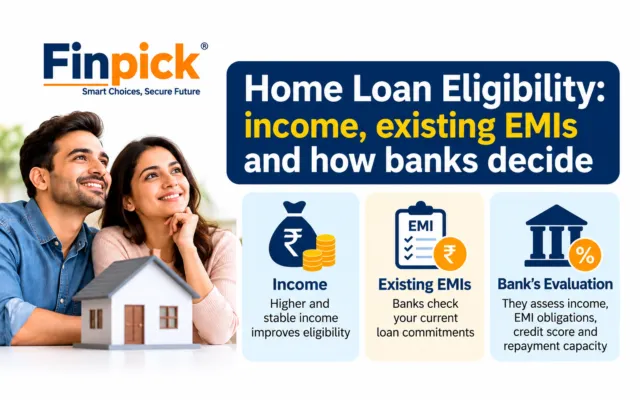
Most lenders cap your EMI at 50 to 60 percent of your net monthly income (the exact figure varies by lender and your credit profile). When you apply jointly, the lender adds both incomes and applies the same cap to the combined figure. That raises the EMI you can afford, which in turn raises the loan amount you qualify for.
A worked example (illustration only, not a projection): Suppose Spouse A earns ₹80,000 a month net and Spouse B earns ₹50,000 net. Combined monthly income: ₹1,30,000.
If the lender allows an EMI up to 50 percent of net income:
- A alone: EMI room = 50% of ₹80,000 = ₹40,000 per month
- A and B jointly: EMI room = 50% of ₹1,30,000 = ₹65,000 per month
At an interest rate of 8.5 percent for 20 years, a ₹40,000 EMI supports a loan of roughly ₹46 lakh, while a ₹65,000 EMI supports roughly ₹75 lakh. That’s ₹29 lakh more borrowing capacity.
HDFC Bank, ICICI Bank and State Bank of India all confirm that pooling incomes in a joint application makes you eligible for a higher loan amount, subject to the bank’s income documentation requirements.
Do this today: Pull your latest salary slips and your spouse’s. Calculate combined net monthly income. Use your bank’s online eligibility calculator to see the loan amount you qualify for alone and jointly.
How Much Tax Can You Save?
Under the old tax regime, you can deduct interest paid on a home loan for a self-occupied property up to ₹2,00,000 per financial year under Section 24(b), provided the capital was borrowed on or after 1 April 1999 and construction or purchase was completed within five years. You can also deduct principal repayment up to ₹1,50,000 under Section 80C (which also includes other instruments like PPF, ELSS and life insurance premiums).
When the property is co-owned and both of you are co-borrowers servicing the EMI, each co-owner can claim these deductions separately on the portion of interest and principal each actually pays. HDFC Bank and ICICI Bank both confirm that each co-applicant is eligible individually for the deduction, so collective tax benefits can be higher.
The goosebumps moment: In the early years of a large loan, when interest is high, two co-owners can together claim ₹4 lakh of interest deduction instead of ₹2 lakh. If you’re both in the 30 percent tax slab, that’s ₹60,000 saved in tax every year.
Continuing the worked example: Suppose the annual interest paid in the first year is ₹6,00,000 (common in the early years of a large loan). If A is the sole borrower under the old regime, A can claim a maximum of ₹2,00,000 under Section 24(b). The remaining ₹4,00,000 is lost.
If A and B are co-owners and co-borrowers, each servicing half the EMI:
- A claims ₹3,00,000 of interest, capped at ₹2,00,000
- B claims ₹3,00,000 of interest, capped at ₹2,00,000
- Total household deduction: ₹4,00,000 instead of ₹2,00,000
If both are in the 30 percent tax slab, that’s an extra ₹60,000 saved in tax in that year (₹2,00,000 × 30%).
On the principal side, suppose ₹1,20,000 is repaid in the year. If A claims it alone, A gets ₹1,20,000 under 80C (subject to the ₹1.5 lakh overall ceiling). If A and B split it, each claims ₹60,000 under their own 80C limit, freeing up room in A’s 80C for other instruments.
Do this today: Open your last year’s tax return. Check which regime you used and whether you claimed the full ₹1.5 lakh under 80C. If you did, your spouse’s separate 80C limit is additional room.
Three Conditions That Trip People Up
The benefit hinges on three conditions:
1. Co-ownership on paper: Your spouse must be a registered co-owner of the property. HDFC Bank states that if the property is jointly owned, all co-owners must be co-applicants in the home loan. ICICI Bank is clear: a co-applicant jointly applies for the loan and may share repayment responsibility and have ownership rights. A co-signer or guarantor, by contrast, pays only if the borrower defaults and cannot claim ownership or tax benefits. If the sale deed or allotment letter lists only one name, the other cannot claim tax benefits, even if both service the EMI.
2. Old tax regime: If either of you has chosen the new regime, that person gets zero deduction for interest or principal. The Income Tax Department confirms that under the new tax regime, interest on a self-occupied property is not allowed as a deduction, and Section 80C deductions cannot be claimed (except 80CCD(2), 80CCH and 80JJAA). Run the numbers for your income level before you decide which regime to pick.
3. Actual payment: The claim is tied to the amount each person actually pays. HDFC Bank and ICICI Bank both say that each can claim tax benefits subject to the amount each individual pays towards principal and interest, and both should service the EMIs. If one spouse pays the entire EMI from their account, the other cannot claim a share without documentation showing a transfer or contribution. Keep bank statements.
Do this today: If you’re in the loan process now, ask the loan officer two questions in writing: “Can we add my spouse as co-applicant, and what documents do you need?” and “Will both our names go on the property registration document?”
What You Need to Check Before You Sign
Income documentation: HDFC Bank says the spouse’s income can be considered for home loan eligibility subject to availability of income documents. If your spouse is self-employed or has variable income, ask your lender in writing what documents they need.
Property registration: The property document must list both of you as owners. This is not automatic. Instruct your lawyer or builder before registration.
Tax regime choice: Use the Income Tax Department’s regime comparison tool (available on incometax.gov.in) or ask your chartered accountant to calculate which regime saves you more, factoring in these deductions.
Payment trail: If you want to claim equal shares, set up standing instructions from both accounts or transfer your share to the primary account every month. Keep bank statements to support your claim at tax-filing time.
Lender certificate: The Income Tax Department requires a certificate from the lender showing interest paid for Section 24(b). Most banks issue this annually. Download it before filing your return.
Five-year completion rule: If construction or purchase is not completed within five years of borrowing, the ₹2 lakh interest cap does not apply, and only ₹30,000 can be claimed until completion. Check your loan sanction letter for the disbursement date and your builder agreement for the possession date.
Do this today: If you’re planning to buy in the next year, book a 30-minute call with your chartered accountant. Take your salary slips, your spouse’s salary slips, and an estimate of the loan amount you’re considering. Ask them to model your tax saving under both regimes with and without a joint loan.
Frequently Asked Questions
Can my spouse claim tax benefits if they are a co-applicant but not a co-owner? No. ICICI Bank and HDFC Bank both state that the co-applicant must be a co-owner of the property to claim tax benefits. A guarantor or co-signer who is not an owner cannot claim.
Does the new tax regime allow these deductions? No. The Income Tax Department confirms that under the new tax regime, interest on a self-occupied property is not allowed as a deduction, and Section 80C deductions cannot be claimed (except 80CCD(2), 80CCH and 80JJAA).
If we split the EMI 60-40, can we claim interest and principal in the same proportion? Banks say each can claim subject to the amount each pays, but the Income Tax Department pages do not state an explicit proportion formula. Consult your chartered accountant and keep payment records (bank statements, transfer confirmations) to support your claim.
Will adding my spouse as co-applicant guarantee a higher loan amount? Not guaranteed, but likely. The lender clubs both incomes, which raises your EMI capacity and therefore your loan eligibility, subject to the lender’s credit policy, your credit scores and the property valuation.
Can we claim these deductions if the property is let out? Yes, but the rules differ. For a let-out property, there is no ₹2 lakh cap on interest under Section 24(b): you can claim the full interest paid. Principal repayment under Section 80C remains capped at ₹1.5 lakh per person.
What happens from 1 April 2026 when the Income Tax Act, 2025 comes into effect? The new Act is expected to renumber and reorganise sections, but whether the limits and conditions for home loan deductions change is not yet confirmed. Check the updated Act text on incometax.gov.in or consult your chartered accountant for FY 2026-27 onwards.
I’ve already taken a loan in one name. Can I add my spouse now? Ask your lender in writing whether you can add a co-applicant to an existing loan. If yes, you will also need to re-register the property to add your spouse as co-owner. Consult your lawyer for the process and stamp duty implications in your state.
What to Do Next
A joint home loan with your spouse can raise your borrowing power by ₹20 to ₹30 lakh and, under the old tax regime, double your household’s tax deduction on interest and principal. The eligibility boost is immediate and applies regardless of which tax regime you choose. The tax benefit applies only if you pick the old regime, both of you are co-owners on the property document, and both service the EMI with a clear payment trail.
The mechanism is straightforward, but the paperwork matters. Co-ownership must be on the sale deed or allotment letter. Payment must be traceable through bank statements or transfer records. You need a lender certificate at tax-filing time.
If you’re planning to buy in the next year, model the numbers now. If you’ve already taken a loan in one name, ask your lender and your lawyer whether you can add your spouse and re-register the property.
Do this today:
- Pull your latest salary slips and your spouse’s. Calculate combined net monthly income.
- Use your bank’s online home loan eligibility calculator. Enter your income alone, then enter combined income. Note the difference in loan amount.
- Open your last year’s tax return. Check which regime you used and whether you claimed the full ₹1.5 lakh under 80C.
- If you’re in the loan process now, ask the loan officer in writing: “Can we add my spouse as co-applicant, and what documents do you need?” and “Will both our names go on the property registration?”
- WhatsApp a FinPick adviser with one number: your combined monthly income. We’ll model your loan eligibility with and without a co-applicant, show you the tax saving under both regimes, and walk you through the documentation checklist before you sign.
You’re not buying a product. You’re structuring a decision that will shape your cash flow and your tax return for the next 15 or 20 years. Get the structure right at the start.