

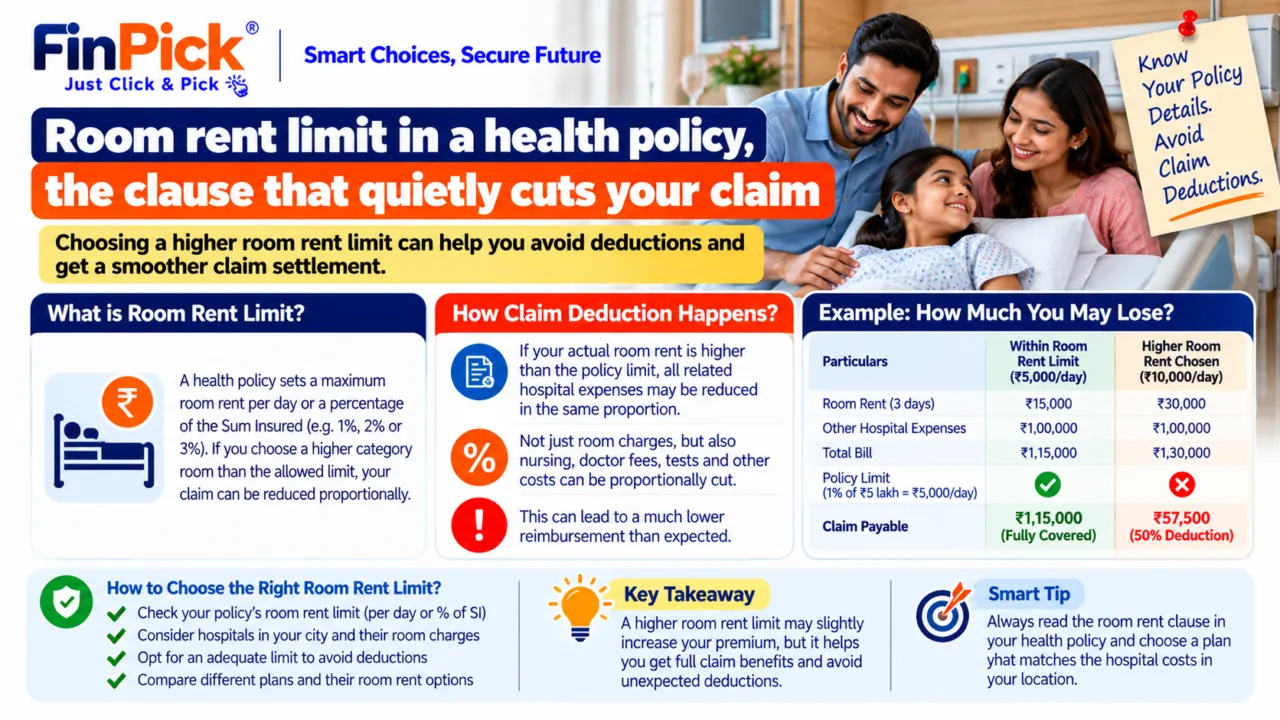
You’re in hospital. The surgery went well. Then the bill arrives, and your insurer pays ₹75,000 of a ₹1,50,000 claim. You expected a small deduction for the nicer room you chose. Instead, half the claim vanished. Welcome to proportionate deduction, the room rent clause that scales down not just your room rent but also nursing, doctor fees, operating theatre charges and anaesthesia by the same ratio.
Most health insurance buyers glance at the sum insured and the premium, then sign. The room rent limit, buried in the policy wording, gets a quick nod. It sounds minor: “1 percent of sum insured per day” or “₹5,000 room limit”. But when you’re admitted and the only available room costs ₹8,000 a day, that limit triggers a calculation that can cut thousands of rupees from lines you thought were fully covered.
What Happened
In June 2020, the Insurance Regulatory and Development Authority of India (IRDAI) issued guidelines to bring clarity to proportionate deduction. Insurers were told to define exactly which expenses count as “associated medical expenses” and which do not. The rules took effect for new policies from 1 October 2020 and for existing products by 1 April 2021. The guidelines protect certain items (pharmacy, implants, diagnostics) from the deduction and advise against applying it to ICU charges or at hospitals without differential room billing. But the core mechanism remains: if you pick a room above your limit, the insurer scales down associated expenses by the ratio of eligible rent to actual rent.
Key Facts
- Room rent limits come as no cap, a fixed rupee amount per day (for example ₹5,000), a percentage of sum insured (often 1 to 2 percent a day), a room category limit (single AC, twin sharing), or a no-limit add-on rider.
- Some policies use both a fixed amount and a percentage, and the lower of the two applies.
- If the room you choose costs more than the limit, the insurer scales down associated expenses by eligible rent divided by actual rent, not just the room rent line.
- With a percentage limit, 1 percent of a ₹3 lakh sum insured is ₹3,000 a day; 1 percent of ₹15 lakh is ₹15,000 a day.
- IRDAI guidelines of June 2020 require insurers to define “associate medical expenses” and prohibit proportionate deductions on anything else.
- Pharmacy, implants, medical devices and diagnostics cannot be included in the proportionate deduction.
- Insurers were advised not to apply proportionate deduction to ICU charges, since ICU has no differential room categories.
- Proportionate deduction cannot apply at hospitals without differential billing, and this must be stated in policy terms.
- Room rent, nursing, doctor fees, operating theatre, anaesthesia, blood and oxygen are commonly listed as associated expenses subject to deduction; medicines, diagnostics, implants and consumables are not (definitions vary by policy).
- A higher sum insured raises the percentage-based limit: 1 percent of ₹15 lakh is ₹15,000 a day versus ₹5,000 for ₹5 lakh.
- Options to avoid deduction include a policy with no room rent cap, a room rent waiver rider, porting to a no-limit policy, or a super top-up.
- A lower room category or sharing room reduces premium, which is the trade-off behind caps.
- Room rent capping is listed among common causes of health claim reductions or rejections in an IRDAI annual report summary.
Why It Matters
The room rent limit is not a line-item cap. It’s a multiplier that runs through your entire bill. If your limit is ₹5,000 a day and you take an ₹8,000 room, the insurer pays 62.5 percent (5,000 ÷ 8,000) of not just the room rent but also the nursing charges, the surgeon’s fee, the operating theatre bill and the anaesthesia cost. The rest comes out of your pocket or eats into your sum insured for future claims.
The IRDAI guidelines offer some protection. Your pharmacy bill, the stent the surgeon implanted, the MRI scan and the blood tests are outside the deduction. But the surgery itself, the post-op nursing and the doctor’s daily rounds are inside it. The line between the two is defined in your policy wording, and definitions vary.
For a family with a ₹5 lakh policy and a 1 percent daily limit, a five-day stay in a ₹10,000 room instead of a ₹5,000 room can mean paying an extra ₹40,000 to ₹50,000 out of pocket, even if the sum insured is enough to cover the full bill. That’s the difference between a manageable co-pay and a financial setback.
How It Actually Works
The mechanism is a ratio. The insurer divides the eligible room rent (your policy limit) by the actual room rent (what the hospital charged). It then multiplies every associated expense by that ratio.
Step one: identify your room rent limit. If your policy says “1 percent of sum insured per day” and your sum insured is ₹5 lakh, your limit is ₹5,000 a day. If it says “₹3,000 per day”, that’s your limit.
Step two: compare the limit to the room you chose. If the hospital room costs ₹8,000 a day, the ratio is 5,000 ÷ 8,000 = 0.625, or 62.5 percent.
Step three: the insurer applies that ratio to the associated expenses. If room rent, nursing, doctor fees and operating theatre charges together total ₹1,20,000, the insurer pays 62.5 percent of that: ₹75,000. You pay the remaining ₹45,000.
Step four: pharmacy, diagnostics, implants and consumables (subject to your policy’s definition) are billed separately and are not subject to the deduction, as long as they are covered under the policy.
The ratio is recalculated for each day if room rates change during your stay.
Who Is Affected
Anyone with a health insurance policy that has a room rent limit is affected. That includes individual policies, family floaters and group health insurance provided by employers. The impact is sharpest for:
- Policyholders with a percentage-based limit and a modest sum insured (1 percent of ₹3 lakh is ₹3,000 a day, which buys a shared room in many tier-1 city hospitals).
- Families admitted to hospitals in metros, where room rates start at ₹6,000 to ₹8,000 a day for a single AC room.
- Senior citizens, who often need longer stays and whose policies may have lower sum insured amounts due to premium constraints.
- Employees under group policies, where the employer may have chosen a cap to keep premiums low.
Policyholders with no room rent cap or a high fixed limit (₹10,000 or more a day) are less affected, but they pay higher premiums for that protection.
A Worked Example
Let’s put rupee figures to it. This is an illustration to show the arithmetic, not a projection of any real claim.
You hold a health insurance policy with a sum insured of ₹5 lakh and a room rent limit of 1 percent of sum insured per day. That gives you ₹5,000 a day.
You’re admitted for surgery. The hospital assigns you a room at ₹8,000 a day. You stay for five days.
The bill breaks down as follows:
- Room rent: ₹40,000 (₹8,000 × 5 days)
- Nursing charges: ₹25,000
- Doctor consultation: ₹20,000
- Operating theatre: ₹30,000
- Anaesthesia: ₹15,000
- Pharmacy (medicines): ₹20,000
- Diagnostics (blood tests, X-ray): ₹10,000
Total bill: ₹1,60,000.
The insurer calculates the ratio: ₹5,000 (eligible) ÷ ₹8,000 (actual) = 0.625, or 62.5 percent.
Associated expenses (room rent, nursing, doctor, OT, anaesthesia) total ₹1,30,000. The insurer pays 62.5 percent of that: ₹81,250. You pay ₹48,750 out of pocket for those lines.
Pharmacy and diagnostics (₹30,000) are outside the deduction under IRDAI guidelines, so the insurer pays the full ₹30,000, subject to policy terms and sub-limits.
Total insurer payout: ₹81,250 + ₹30,000 = ₹1,11,250. You pay ₹48,750.
If you had chosen a ₹5,000 room, the insurer would have paid the full ₹1,30,000 for associated expenses (subject to sum insured), and your out-of-pocket cost would have been zero for those lines.
The ₹3,000 daily room upgrade cost you ₹48,750 in deductions over five days.
FinPick Analysis
The room rent limit is a premium trade-off dressed up as a small clause. Insurers price policies assuming you’ll use a certain category of room. If you pick a higher category, they recover the difference not by charging you more at admission but by scaling down the payout across the bill. It’s actuarially sound, but it catches buyers off guard because the policy document doesn’t show the worked example above.
The IRDAI guidelines of June 2020 were a step forward. Protecting pharmacy, implants and diagnostics from the deduction prevents the worst-case scenario, where a stent or a diagnostic scan is also cut by 40 percent. But the core mechanism remains, and it still applies to the biggest lines: surgery, nursing and doctor fees.
The real decision point is at purchase. A ₹5 lakh policy with a 1 percent limit gives you ₹5,000 a day. A ₹10 lakh policy with the same percentage gives you ₹10,000 a day, which covers a single AC room in most cities. A ₹15 lakh policy gives you ₹15,000 a day, which is close to a deluxe room. The premium difference between ₹5 lakh and ₹15 lakh can be ₹8,000 to ₹12,000 a year for a 35-year-old, depending on the insurer. That’s less than the out-of-pocket cost of one proportionate deduction.
Alternatively, a room rent waiver rider or a no-cap policy costs more upfront but removes the deduction entirely. The trade-off is clear: pay a higher premium now, or risk paying a larger amount out of pocket later.
For families on a budget, the arithmetic favours a higher sum insured over a lower one with the same percentage limit. For those who can afford it, a no-cap policy or a waiver rider is the cleanest solution.
What You Should Know Before You Act
Before you renew or buy a health policy, check these:
- What is your room rent limit? Is it a fixed amount, a percentage, or a category? If it’s a percentage, calculate the rupee figure (sum insured × percentage ÷ 100).
- What does your policy define as “associated medical expenses”? This list determines what gets cut. Nursing, doctor fees, OT and anaesthesia are almost always included. Pharmacy, diagnostics and implants should be excluded under IRDAI guidelines, but read your policy wording to confirm.
- Does your insurer apply proportionate deduction to ICU charges? IRDAI advised against it, but policy wordings vary.
- Does the policy state that proportionate deduction will not apply at hospitals without differential billing? This is required under IRDAI guidelines.
- If you’re considering a higher sum insured, calculate the new daily limit and compare it to typical room rates in your city.
- If you’re considering a room rent waiver rider or a no-cap policy, compare the premium loading to the potential out-of-pocket cost of a deduction.
If you’re already holding a policy with a low limit and you’re due for renewal, ask your insurer about porting to a no-limit plan or adding a waiver rider. Porting resets the room rent clause without a fresh waiting period for pre-existing conditions.
Frequently Asked Questions
Q: If I choose a room below my limit, does the insurer pay me the difference?
A: No. The limit is a ceiling, not a reimbursement target. If your limit is ₹5,000 and you take a ₹3,000 room, the insurer pays ₹3,000. You don’t get the extra ₹2,000.
Q: Does proportionate deduction apply to day-care procedures where I’m not admitted overnight?
A: Room rent limits typically apply only to in-patient hospitalisation, not day-care procedures. But check your policy wording, as definitions vary.
Q: Can I upgrade my room mid-stay if I’m willing to pay the difference?
A: You can request a room change, but the insurer will recalculate the ratio for each day. If you move from a ₹5,000 room to an ₹8,000 room on day three, days one and two are paid in full, and days three onwards are subject to proportionate deduction.
Q: What if the hospital has only one type of room and it’s above my limit?
A: IRDAI guidelines state that proportionate deduction cannot apply at hospitals without differential billing. If the hospital genuinely has no lower-category room, the insurer should not apply the deduction. This must be stated in your policy terms. In practice, ask the insurer to confirm in writing before admission.
Q: Does a super top-up policy have a room rent limit?
A: Some super top-ups have no room rent limit, which is one reason they’re used to layer over a base policy with a cap. But not all super top-ups are no-cap, so read the terms.
Q: If I port to a no-cap policy, do I lose my no-claim bonus or waiting period credit?
A: Porting within the same insurer or across insurers (under IRDAI portability rules) preserves your waiting period credit and no-claim bonus, subject to underwriting. The new policy’s terms (including room rent) apply from the date of porting.
Conclusion
The room rent limit is not a footnote. It’s a lever that can cut your claim by 30 to 50 percent if you pick a room above the cap. The IRDAI guidelines of June 2020 protect pharmacy, diagnostics and implants from the deduction, but surgery, nursing and doctor fees remain inside the calculation. The arithmetic is straightforward once you see it: eligible rent divided by actual rent, multiplied by associated expenses.
The fix is at purchase. A higher sum insured raises the percentage-based limit. A no-cap policy or a room rent waiver rider removes the deduction entirely. The premium difference is real, but it’s smaller than the out-of-pocket cost of one proportionate deduction on a major surgery.
Read your policy wording. Calculate your daily limit. Compare it to room rates in your city. If the gap is wide, consider porting or upgrading before you need to use the policy. The time to fix a room rent limit is now, not when you’re checking into hospital.
Do this today:
- Pull out your health insurance policy document and find the room rent clause. Write down whether it’s a fixed amount, a percentage, or a category.
- If it’s a percentage, calculate the rupee figure: sum insured × percentage ÷ 100. That’s your daily limit.
- Look up the room rates at two hospitals near you (call the billing desk or check the hospital website). Compare them to your limit.
- If your limit is below the typical single-room rate in your city, calculate what a five-day stay would cost you under proportionate deduction using the worked example above.
- Bring those numbers to a call with a FinPick adviser. We’ll show you the premium difference for a higher sum insured, a no-cap policy, or a waiver rider, and help you decide whether to port or upgrade before your next renewal.
Reply with your current sum insured and your city, and we’ll walk you through the room rent arithmetic for your situation.